Compare HTC Vive vs HTC Vive Focus Vision
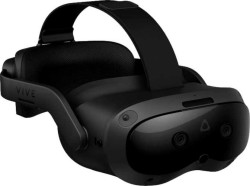
In this technical comparison between the HTC Vive and the HTC Vive Focus Vision, we analyze the key features to help you choose.
The display is a highlight, featuring a resolution of 2160 × 1200 total (1080 × 1200 per eye) for the Vive versus 2448 × 2448 pixels per eye (5K Combined) for the Vive Focus Vision.
Choosing between these two VR Headsets models often comes down to your budget, with prices around $799 (at launch) and $999 USD (Consumer Edition) / ~$1,499 USD (Business Edition).
| Specifications |
HTC Vive |
HTC Vive Focus Vision |
|---|---|---|

|
|
|
| Launch | ||
| Release Version | April 2016 | October 2024 |
| Display | ||
| Sensor Technology | Dual PenTile OLED | Dual Fast-switch LCD Panels |
| Image Resolution | 2160 × 1200 total (1080 × 1200 per eye) | 2448 × 2448 pixels per eye (5K Combined) |
| Refresh rate | 90Hz | 90Hz (Up to 120Hz via DisplayPort mode) |
| Field of view | ~110° | Up to 120° |
| Brightness | ~200 nits (High-contrast OLED) | Optimized for high-fidelity VR |
| HDR | No | No (Standard LCD) |
| Optics | ||
| Lens type | Fresnel | Dual-element Fresnel Lenses |
| IPD adjustment | Hardware-adjustable dial (61mm--72mm) | Motorized Auto-IPD adjustment (57mm – 72mm) |
| Eye relief | Lens-to-face distance adjustment (adjusted by pulling and twisting the side knobs) | 150mm wide facial interface (designed to accommodate glasses) |
| Tracking & Input | ||
| Tracking type | SteamVR Tracking 1.0 (Outside-in via "Lighthouse" Base Stations) | 6-DOF Inside-out via 4 tracking cameras |
| Controller tracking | 360-degree tracking via external laser base stations | 6-DOF VIVE XR Controllers (included) |
| Hand tracking | No | es (26-point precision; assisted by infrared floodlight) |
| Eye tracking | No | Built-in (120Hz gaze data output) |
| Facial tracking | No | Supported (requires separate VIVE Facial Tracker accessory) |
| Performance | ||
| Processor / Chipset | None (PC-powered) | Qualcomm Snapdragon XR2 Gen 1 |
| RAM | PC Dependent (4GB+ minimum) | 12GB LPDDR5 |
| Storage | No | 128GB (Expandable up to 2TB via MicroSD) |
| Mixed Reality Features | ||
| Passthrough | Single front-facing VGA camera (used for "Chaperone" safety bounds) | Dual 16MP Color cameras (Stereoscopic Full-Color) |
| Depth sensing | No | Dedicated Depth Sensor for scene understanding and mapping |
| Audio | ||
| Built-in audio | None (Included earbuds were separate) | Dual-driver directional speakers (open-back design) |
| 3.5mm jack | Yes | Yes |
| Mic | Yes | Dual microphones with noise and echo cancellation |
| Connectivity | ||
| Wired | 3-in-1 Tether Cable (HDMI 1.4, USB 2.0, and 12V Power) to Link Box | USB-C 3.2 Gen 1 with DisplayPort Alt Mode support |
| Wireless | Supported via optional Vive Wireless Adapter (Intel WiGig) | Wi-Fi 6 / Wi-Fi 6E |
| Bluetooth | Yes (Built into the Link Box for Base Station power management) | Bluetooth 5.2 + BLE |
| PCVR support | Native (SteamVR / Viveport) | Yes (Lossless via Wired DisplayPort or Wireless via VIVE Streaming) |
| Compatibility | ||
| Platforms | SteamVR, Viveport | VIVE Business, SteamVR (via PC), Viveport |
| Supported OS | Windows 7 SP1, 8.1, 10, 11 (Linux and macOS support experimental/limited) | VIVE XR (Android-based) / Windows (for PCVR) |
| Comfort | ||
| Weight | ~555g (Original 2016 model); ~470g (2017 weight-reduced revision) | ~700g+ (Balanced 50-50 weight distribution) |
| Strap type | Elastic Velcro "T-strap" (Rigid Deluxe Audio Strap sold separately) | Rigid strap with rear-mounted battery and adjustment dial |
| Face interface | Replaceable foam gasket | Replaceable PU leather cushions (Magnetic) |
| Battery | ||
| Battery life | N/A (Headset is wired); Controllers last ~6 hours | Up to 2 hours |
| Charging method | N/A (Headset); Micro-USB for controllers | USB-C (30W Fast Charging) |
| External battery support | N/A | Hot-swappable; includes a built-in reserve battery (20-min standby) |
| Misc | ||
| Inside the box | Headset, 2x Wireless Controllers, 2x Base Stations 1.0, Link Box, Earbuds, 3-in-1 Cable, Power adapters, and mounting hardware. | Headset, 2x Controllers, Battery, 30W Adapter, Charging Splitter, Lens Cloth |
| Price | $799 (at launch) | $999 USD (Consumer Edition) / ~$1,499 USD (Business Edition) |
| Full Details | Vive - Full Specifications | Vive Focus Vision - Full Specifications |